

Living Legacy - May 2026

I’m a few days late with my reflections this month because I’ve been busy moving house. We’re now the proud custodians of a 350 year-old farmhouse which has the potential to be beautiful, if we manage to crack on through all the jobs on the list!
And it’s got me thinking about the part we each play in shaping history. This month, as people are inevitably seeing their teams starting to shift with promotions, retirements and new recruits, either for this term or September, I invite a pause for thought around what we leave behind us when we move on to pastures new.
How have people benefitted from your work? What have you made better by cracking on through your job list, both for the here and now, and for the years to come for future children and colleagues?

The concept of a ‘living legacy’ has been famously espoused by the All Blacks rugby team as explained in James Kerr’s ‘Legacy’ and Peter Bills’ ‘The Jersey’. Each numbered shirt comes with a “Little Black Book”, which contains the team’s history, values and an overview of players who have worn that specific jersey number. This is followed by blank pages for the current player to record their own experiences during their time on the team. This reinforces the shared belief that each player must honour those who came before them while paving the way for those who follow; a player is only a temporary contributor and has a responsibility to “leave the jersey in a better place” than they found it. This may well resonate with education leaders at all levels.


I recently had a call with an Assistant Headteacher interested in building a coaching culture and we soon discovered that my Dad had been her Year 6 teacher! She excitedly recalled his science experiments and music lessons and told me she’d bought him a treble clef tie pin as a leaving present. A tie clip which it turns out my Dad, aged 86, still displays on his bureau, as a reminder of his pupil's appreciation and his joy in encouraging her engagement in a love of music and, it seems, education in general.
If you’ve experienced a child or colleague going out of their way to extend a personal thank you for the difference you’ve made to them, were you able to accept their appreciation but also take a moment to reflect on how that positive contribution may have rippled far wider than that single individual?
In education, we do not function in silos. We are an integral part of a wide and deep culture: functioning within a living, response, organic community. The ripples of our actions are therefore often felt much wider that we will ever see… both across more people (eg pupils' families and our colleagues) and into the future (eg within workplaces and adult relationships).
It’s easy to have a blindspot to these as we're busy cracking on with the to-do list. So I encourage you to find 10 minutes to make a list of all the things you have achieved in your role, and the impact they had had so far (past), are currently having (present) and are likely to have (future).
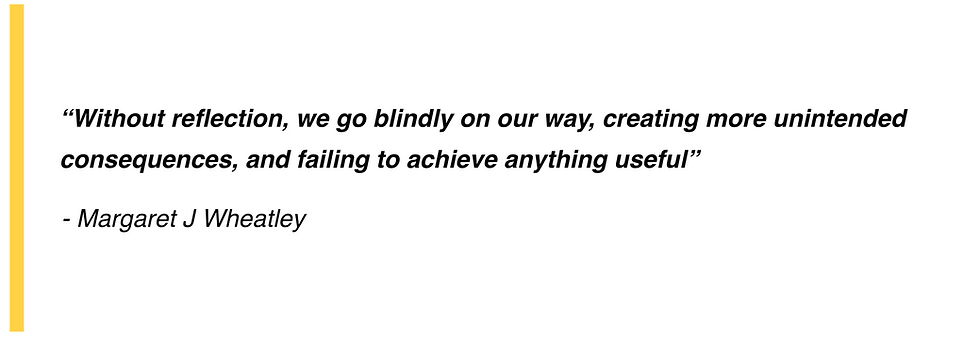
And when thinking about ‘what’s next?’, it’s never too late to set some intentions around what you’d like to achieve: whether you’re thinking about your new start, how to leave your current role, or how to re-energise it. Perhaps this could be a topic for your next coaching session?
Wherever you're at in your legacy-setting, Stanier's practical workbook ‘How to Begin’, offers three helpful criteria in creating a fulfilling and ‘Worthy Goal’:
Is it important?
Is it daunting?
Is it thrilling?
He encourages taking these steps:
Create a ‘messy first draft’ right now! One sentence!
Refine into a specific, actionable ambition
Commit fully, identifying both what you will need to do and not do
Take the first step, no matter how small, to start building belief and momentum
Harness support from both people and systems

Through an exercise like this, you will naturally tap into your intrinsic motivation and core values: what really matters to me? What difference do I want to make? This naturally dovetails into succession planning: what happens when I leave? What lives on? Can I melt into the background and see the shift I’ve helped to create survive in my absence?

Creating a resourcefulness and self-sufficiency in colleagues is a key attribute of a successful leader, empowering others to see the strength in themselves. Like the All Blacks’ jersey, will you be handing over your Little Black Book with pride in what you have contributed and, as importantly, in the belief that its benefits will live on?

We know that working in education can be really tough. Pepe Di’Iasio spoke about this in his recent keynote at the ASCL Annual Conference, quoting Michelle Obama, “When they go low, we go high.” So let us rise up now to take a helicopter view at what it is you’re creating which will enhance the provision and experience within your school or Trust or wider community - both now and into the future:
What do you want your leadership to have made possible?
What are you intentionally building now that will sustain beyond your tenure?
How aligned are your daily decisions and actions with the legacy you hope to leave behind?
Whatever this term holds, we know it is leading us towards the end of the academic year, bringing together a huge culmination of different people’s ideas, effort and developmental journeys. Remembering the mission that you’re on, both individually and collectively, should make your end of year celebrations even more meaningful, regardless of the official outcomes. By getting clear now, you've a better chance of leaving 2025-26 more fulfilled and nourished, in the knowledge that you've truly made a positive and lasting contribution to the history of an important shared story.

Warmest wishes,

Catherine Hulme
Owner Director


If you enjoyed this, please share with colleagues.
Connect with us on LinkedIn for more.
Leadership Edge is a growing team of experienced school leaders who have seen person-centred coaching create high-performing, happy and healthy cultures within our schools. Our mission is to empower other school leaders to create positive workplaces where staff are solution-focused and actively responsible for their own personal wellbeing and professional development.
Our 3-Tier Coaching Accreditation Programme is low-cost and self-sustaining, providing a systematic and structured model for staff across your school to become powerful coaches for each other, enhancing colleague relationships and their feeling of being valued as an individual within a supportive school community.



Comments